Support WU
A-Z Index


Willamette Stories

Willamette Grounds Even Greener Than You Thought

headshot

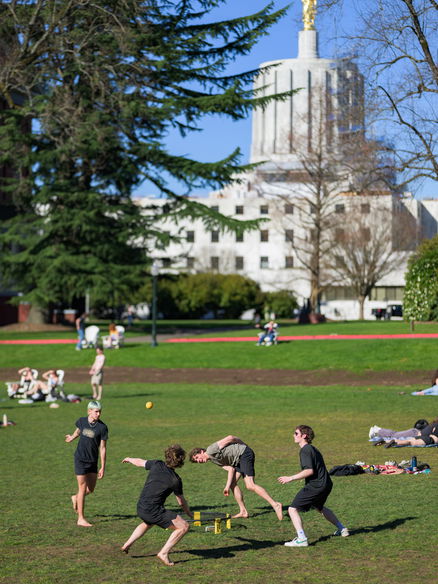
Oregon travel guides rave about Willamette University’s natural beauty and The Oregonian named the campus one of the most beautiful urban walks in the state. New grounds manager Jim Andersen and his crew prefer not to take all the credit. “We’re fortunate to be where we are,” Andersen says. “It’s pretty easy when Mother Nature does the job.”

Now they are relying on Mother Nature to do even more, as they pioneer a greener way of caring for Willamette’s landscape. And since they’re ahead of the curve as far as institutional landscapes, strategies aren’t well developed. They’re figuring it out on their own, with a little experimentation.

For example, two adjacent lawns served as large-scale test plots last year. One received the traditional treatment of synthetic fertilizers and weed killers; the other was sprayed with organic compost tea. “The natural lawn is more lush now,” Andersen says. “Traditional fertilizers work quickly, but they may not be as good for the long-term health of the soil. Now crews mow higher, leave lawn clippings on the lawn as natural sources of nitrogen, water less and let some corner lawns go dormant in the summer. We want lawns that take care of themselves.”

The natural approach also extends to flower gardens, where pesticide use was reduced more than 80 percent last year. Weed treatment begins with applications of vinegar and mulch rather than Roundup, and when time runs short, stray weeds in corner areas of campus are tolerated with a conscious “mindful neglect.” Individual employees have also created unique micro-gardens with diverse plant palettes, like the Asian garden near the law building and the water garden between the York and Lee Buildings.

“We’re in the infancy stages,” Andersen says. “It’s important to preserve the history of the place, including the history of the plant life, but sustainability gives us an exciting new avenue to explore.”

[ posted august 15,2008 – last friday ]
 

Getting an Education on the Streets of Portland

headshot

“Some students said the Take a Break trip is a very nice experience, but I had few English skills so I didn’t have the courage to join,” says Willamette junior Yuki Sugisawa ’09.

Until last spring, that is, when Sugisawa signed on to spend eight days on the streets of Portland with the homeless. Willamette students organize the alternative spring break trips each year and fan out across the country, volunteering in homeless shelters, inner city schools and impoverished rural neighborhoods. Instead of a break at the beach, they take steps toward stewardship of their local and national communities, addressing literacy, poverty, racism, hunger, homelessness, HIV/AIDS and the environment.

“It was my first intense exposure to the volunteer experience,” says Sugisawa. “We talked to the homeless people, and they were very kind. They tried to take care of each other and of us. For their community, we were visitors. We asked, ‘Where are you from?’ and asked about their lives, but we didn’t ask directly. They are careful and so we used appropriate language.”

Sugisawa met a man who has a wife, a job, no drug or alcohol problems, and a disability — with no insurance. “I could tell he is a good person. He was reading newspapers to find a better life.

“This trip broke a lot of my stereotypes and made my point of view expand. If I don’t talk to those who have different perspectives from my own, my vision will be very narrow. Before I thought studying was much more important, but now I know I need experience, too. For me, this connects my education and real life. Volunteering is important to understand how we are linked to each other.”

Sugisawa has also mentored children at a local elementary school and will volunteer this year with Salem’s Colonia Libertad, a Salem program that provides education and proper housing for Spanish-speaking immigrant farm workers. “I want to study the Latino culture,” says Sugisawa, who began college at Tokyo International University of America (TIUA), a partner school to Willamette. “In class I have heard about how immigrants struggle to identify themselves in the U.S. I have the very same experience.

“Should I hang out more with my Japanese friends and talk Japanese, or should I hang out with Willamette friends and learn more English? Day by day, I’m changing here. Before, my only focus was to improve my English, but now I’m standing between the boulder that is Japanese society and the boulder that is U.S. society. It’s difficult to categorize or identify myself, so I have a sympathy for Latin American immigrants.”

Sugisawa, called the “philosopher of the trip” by his teammates, is majoring in international studies and hopes to work at the United Nations someday. “I would like to change even a little piece of the world.”

[ posted august 12,2008 – nine days ago ]
 

No Grass Growing Under Her Feet

headshot

Whew!

When Paige Folsom ’06 talks about all her adventures since leaving Willamette, this seems like the appropriate response. She’s only been gone two years, but in that time she has worked as a sternperson on lobster boats in Maine, taught English in Spain, and returned to her hometown of Tacoma, Wash., where she now holds three jobs: writing for a quarterly health publication, assisting community college students with their writing, and acting as site coordinator for a middle school mentoring program. And she just enrolled in a master’s program for teaching at the University of Puget Sound.

Folsom recently was awarded a Fulbright Grant for U.S. Students that will take her to Argentina, where she will work in a training college for English as a second language (ESL) teachers. It’s an exciting prospect, but how will she find the time?

“Attaining balance has been a challenge for me,” she admits. “But I’m motivated by love of languages and art, love of learning, and by feeling compelled to serve, heal and connect in the community, even in small ways. I try to dedicate myself to things that combine all three.”

Even while she was at Willamette, Folsom was active. An English major for whom all disciplines converge in English language and literature, Folsom also found time to play lacrosse and intramural soccer, be a resident assistant, study abroad in Spain and India, participate in the Take a Break alternative spring break service program, and volunteer at a local school and a youth program, among other activities.

She obviously isn’t afraid to try new things. Like catching lobsters in Maine, which she did during the summers after her junior and senior years.

“While visiting a friend, I overheard her older brother teasing their mom about needing a summer sternman on his lobster boat,” she says. “She told him that rotten bait wasn’t her thing, and that she preferred to keep her day job. After thinking about it for a moment, I walked up to him and said, ‘Well, I’ll do it,’ and he hired me to work on a boat called the Spicy Pepper. He taught me a lot about fishing and eventually I worked my way onto other boats.”


After returning from her second venture into East Coast fishing waters, she crossed the ocean to spend eight months in northern Spain. She taught conversation classes and helped middle- and high-school English teachers in Gijón in the Asturias principality. She also became a private English tutor. “I stayed in Spain for the summer to continue classes with my private students and experience all the seasons of Asturias. Summer festivals are an important part of the region’s culture. I also wanted to hike at higher elevations in Los Picos (a mountain range in the area) with mountaineer friends as the snow melted, participate in some swimming events and spend time on the coast in warmer weather.”

Her work as an ESL instructor helped her discover her calling to teach, and her eventual goal is to teach high school English. Her time in Spain also piqued her interest in Argentina. A burgeoning international film scene in Gijón exposed her to a variety of Argentine films, and she learned about strong transatlantic connections between Europe and Argentina.

“Most of my Galician (a northern Spain community) and Asturian friends speak about entire branches of their families who immigrated to Argentina in the early 20th century. I heard similar stories from Italian travelers I hosted in Gijón through an online project, and from Croations I met while reconnecting with my own extended family and Slavic roots in Croatia.”

Folsom hopes to spend part of her time in Argentina studying “lunfardo,” a set of invented words known worldwide as the vocabulary of the tango. Lunfardo was influenced by the immigrant community in Buenos Aires at the turn of the 20th century, and today it is celebrated in tango lyrics and has been absorbed into colloquial speech. Folsom wants to interview people about the use of lunfardo and create an illustrated lexicon of the words and phrases she learns.

Until she heads to South America, Folsom will work on her master’s — she plans to complete the first half before her Fulbright and the second half when she returns. While studying, she will scale back her work hours at her three jobs, which include matching adults in her community with students through the Mentor253 program of the Northwest Leadership Foundation (NLF). The foundation is a faith-based nonprofit that develops and supports social justice programs.

“Our team partners middle school students with adults for one-on-one mentoring and organizes activities for the pairs. Meanwhile, the kids and I have developed our own strong mentoring relationships. These students are teaching me a lot. This summer, I’ll have the opportunity to continue working with many of them at an NLF camp sponsored by Tacoma Housing Authority.”

Whew!

For more information on the Fulbright Grant and others, contact Monique Bourque in the Student Academic Grants and Awards office on the third floor of Putnam University Center, or visit www.willamette.edu/dept/saga.

[ posted august 1,2008 – twenty days ago ]
 

From Salem to D.C.: Fellowship Furthers Student’s Policy Work

headshot

Collin Siu’s whirlwind of jobs during college, researching and influencing public policy, are enough to make most people’s heads spin. But Siu ’08 sees his work as a natural extension of his ultimate goal in life: leaving his community better than he found it.

While at Willamette, Siu served on the ground level for policy organizations and governments in his home state of Hawaii and in his college home of Oregon. This fall he will head to Washington, D.C., for a prestigious national fellowship addressing poverty and hunger policy.

So what inspired his interest in policymaking?

“I think a lot of it has to do with how I feel about the place I live,” he says. “I really love Hawaii, for example, but I think there are things that could be improved. My interest has been in making my community stronger and helping people who are vulnerable. I don’t think I could just have a career where I only make money all day. I want to do something meaningful with my life.”

Siu is one of 20 people recently selected for the Bill Emerson National Hunger Fellowship, a project of the Congressional Hunger Center. He will spend six months with urban or rural community-based organizations involved in fighting hunger and poverty on the local level, followed by six months in Washington, D.C., working on the same issues at national organizations.

“The structure of the fellowship is great,” he says. “You get to work on policymaking in a local community through a national organization. A lot of policymakers don’t consider what people in communities think. They just take a top-down approach. It’s important to have a view that also goes from the bottom-up.”

A double major in Spanish and economics, Siu got his first exposure to government policy during his freshman year at Willamette. He interned across the street in Oregon’s capitol building doing research for state Senate minority leader Ted Ferrioli, R-John Day. During his sophomore year, he did research for one of Oregon Gov. Ted Kulongoski’s general policy advisors. “It exposed me to a diversity of issues,” Siu says. “I researched Indian affairs, driver’s license issues and a network that links Oregon’s after-school programs, to name a few.”

He hopes to return home to Hawaii in the future. The summer after his sophomore year, he worked for the non-profit organization Hawaii Alliance for Community-Based Economic Development, where he researched poverty issues and assisted with strategic planning for a state office to figure out how to better incorporate community views into policy.

He also spent time with the non-profit ALU LIKE Inc., which assists Native Hawaiians in achieving social and economic self-sufficiency. Siu helped design a survey to collect data on whether matched savings accounts could improve life outcomes for poor Hawaiians.

Before he starts his National Hunger Fellowship, Siu heads to D.C. for a summer internship with the Asian Pacific American Institute for Congressional Studies, an organization striving to involve Asians in the political process.

So with all this experience, is political office in Siu’s future? Possibly. But he realizes that getting elected isn’t the only way to make a difference. “Public policy is this really amorphous field that keeps growing. It’s not just for politicians. It’s for all individuals working for change in their communities.”

For more information on this scholarship and others, contact Monique Bourque in the Student Academic Grants and Awards office on the third floor of Putnam University Center, or visit www.willamette.edu/dept/saga.

[ posted august 1,2008 – twenty days ago ]
 

Listening as Letting Go

headshot

Cassandra Farrin ’05 was a freshman when the two planes struck the Twin Towers. She had been at Willamette two weeks. A week earlier a friend had been struck by a car; a week later another friend was struck by a car. Both died, and Farrin was in a state of searching.

“We were in class with Professor Dave McCreery and asked him many, many questions,” the religious studies graduate says. “He had spent time in the Middle East and helped us understand the difference between media portrayals and the real Islam.”

It was Farrin’s first experience in thinking across cultures and religions, and it projected her onto a meaningful path, one that is now leading her to graduate studies in comparative religion at the University of Lancaster in Great Britain, courtesy of a Fulbright grant. She competed with more than 500 applicants for 10 spots in a Fulbright exchange program in the U.K.

So how did a young woman from the farm town of Emmett, Idaho — population 6,500 — win one of the most competitive grants in the world? She did it by working hard, of course, but also by being genuinely curious about the world.

“In my studies, I want to compare religions without simplifying, objectifying or judging,” Farrin says. “We can feel threatened by a person whose view of the world challenges our core values, we can allow fear and discomfort to create a protective barrier, or we can take a step toward greater understanding.

“With globalization there’s more border crossing,” she says. “I’m not talking about just geographical borders, but borders of ideas, cultures and religious beliefs. When you connect with ideas from a different context, you can’t argue in terms of black and white anymore. There are too many systems.”

Farrin says her first lesson in listening across cultures came from a deaf student at Tokyo International University in America (TIUA), located at Willamette. “Nao Kawakami read lips,” Farrin says, “and didn’t learn sign language until she came to America. She taught me to listen. Americans create friendship by giving information as a gift, but with Asian friends you’re expected to give conversational space. American culture prioritizes the speaker’s responsibility to convey meaning as clearly as possible, but we don’t always notice how the way we listen impacts a conversation. Developing this skill in inter-religious and intercultural dialogue is an important step toward authentic communication.

“As a freshman, I was a conservative Christian talking across cultures with my TIUA friends, many who believed in a fusion of Buddhism and Shintoism. It was difficult trying to negotiate across culture and religion, until I realized I had to change my questions. We were starting from such different places.”

Farrin gave up playing string bass with the University Chamber Orchestra to create time for her new relationships with TIUA students, but still managed to pack a lot of experience into four short college years. She explored her spiritual vocation in a semester at Yale Divinity School; helped found TellUs, a journal about Study Abroad experiences; and was selected by the college dean to contribute an essay in a university publication about freedom of expression.


After graduation Farrin taught English in Japan — “I wanted to spend time there before the rest of my life started” — but soon returned to TIUA as a campus life assistant and community coordinator. “I still have all the students’ names memorized,” she says, “and I still get emails saying, ‘Do you remember me?’ Of course I do!”

Farrin also filled in as interim director for Willamette’s Community Service Learning, where she helped students organize volunteer trips and activities. “Volunteering is a great way to go into an unfamiliar setting, which is key for learning how to listen to people who are different from ourselves,” she says.

In her graduate studies Farrin plans to look at the nature of listening and its relevance to comparative religion, with an eventual goal of becoming a professor of religious studies. “I hope my students will become more interested in what they don’t understand about others,” she says.

For information about the Fulbright and other scholarships, contact Monique Bourque in the Student Academic Grants and Awards Office on the second floor of the University Center.

[ posted july 15,2008 – last month ]