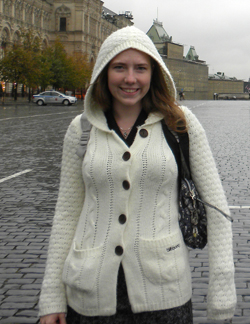

Why did you come to Willamette -- and why did you major in English?
When I began searching for colleges, I knew the basics but honestly didn’t know how to choose. What tipped me in Willamette’s favor was the class I observed when I came as a prospective student. A woman at the registrar’s office asked about my interests, pulled up a list of classes, and personally called a professor to ask if I could attend. It was a 300-level history class on the portrayal of women in medieval texts, and it completely enthralled me! I left that room a future Willamette student.
I didn’t know I was going to be an English major at the start—I thought I was going to major in Psychology. I’ve always loved creative writing, and I took a creative writing class during my freshman year. When it came time to register for classes my sophomore year, I kept changing and changing my schedule to try to make both a creative writing class and a Research Methods and Analysis class fit. Finally, after my fifth or sixth time reworking my schedule, I realized I wanted to do English more than Psychology. I registered for creative writing and never looked back!
How did English complement your other majors in Philosophy and Russian?
Originally, I didn’t realize how much overlap there was between all three. I chose each because it appealed to me individually. However, the farther I went in each field, the more it became clear to me that you cannot actually separate them. The same skills I learned in English courses applied directly to reading and analyzing Russian texts. In fact, my senior thesis in Russian was an analysis of how immigration effects identity as seen through Sergei Dovlatov’s characters. And the preoccupations and concerns of my philosophy major provoked and influenced my senior thesis for English. Every poem in my English thesis, “Tortuga Heights,” begins with a quote from Ludwig Wittgenstein, which allowed me to interact with his ideas outside the realm of traditional philosophy.
Tell me about the process of writing your senior thesis for English?
The instant I found out it was possible to write a creative thesis, I knew I wanted to do that. My adviser and I agreed there should be a joint focus on reading and writing poetry, so we agreed to meet once a week to discuss a book of poems I’d read and the poems I’d been drafting and rewriting. Throughout the semester I had a chance to discover and interact with a wide variety of poets, most of whom influenced my work considerably. The poet who had the greatest influence on my work was probably Lyn Hejinian, who inspired me to work with the prose poem, which became the medium I used for the creative part of my thesis. My adviser worked with me every step of the way, offering both encouragement and constructive criticism. During our meetings, we discussed what stood out both in what I had been reading and in my work. Towards the end, I selected the poems that I felt the most pleased with and we discussed possible alterations and presentation. In the end I created “Tortuga Heights,” a project I’m extremely proud of.
Care to share an excerpt?
Of course! Here’s a poem called “Exchange”:
EXCHANGE
If I now become ashamed of this incident, I am
ashamed of the whole thing: of the words, of the
poisonous tone, etc.
The kiss on the cheek hung in between us. It hung there rigid with rigor mortis—no note attached. The scissors used to cut the silence were cranberry. The silence itself was purple and splotched. She’d forgotten her makeup that day and the tears left no stain where they ran out of the room and down the hall. Too large letters spelled out evanescent messages on scrabble boards that vanished into the smoke of one last cigarette. “Misery loves company.” Sorrows aren’t meant to be drowned but stuffed and she looked on the past with eyes overflowing. One thousand words and counting as pictures are covered with post-it notes. Fists pump their steady rhythm in place of a heartbeat.
You taught English in Russia for 2010-2011 year, right? What was that like?
Well, first of all, teaching English abroad has given me an all-new appreciation for my professors! It was an interesting and challenging experience. I taught all ages (from children to people in their 70s) and all levels. All classes were conducted fully in English; in fact, I was forced to sign a contract that I would not speak a word of Russian with my students, which is pretty normal for private language schools.
As with any job, there were really rewarding moments such as the moment when my 11-13 year olds put me on the list of things they were thankful for when I had them make a list for Thanksgiving; the first time my Beginners asked me “Carrie, please close the door”; and the times my Upper Intermediate students watched an English movie I’d recommended, liked it, and learned from it! But, there were also challenging moments. Teaching children, especially children who don’t understand you, is very difficult, and given how structured large language schools are, there is very little freedom about what to teach.
Outside of the classroom, I was definitely living in a foreign country. Finding grocery stores and learning the word for eggplant was a challenge. Thanksgiving was just another working day for me. However, Victory Day was a huge holiday. Working in Russia both enabled and forced me to really live there.
What are you doing now?
I'm in my second year of law school at Columbia University in New York. Last summer, I worked on women's rights issues in Armenia, including drafting federal anti-stalking and anti-harassment legislation. Currently I'm interning with a non-profit organization that helps victims of domestic violence, preparing multitudes of legal documents. A lot of law is telling the client's story, and I have to say my English background is very helpful for that. And, of course, in my few moments of free time, I'm still an avid consumer of novels and poetry!