Courses
- PPLE 210 – American Politics
- PPLE 315 – Topics in Politics - What's the Matter with American Politics?
- PPLE 331 – Direct Democracy: The Politics and Policy of State Ballot Measures
- PPLE 354 – The American Presidency
- PPLE 358 – American Exceptionalism?: Policy and Politics in Comparative Perspective
- PPLE 396 – Governmental Internship
- PPLE 480W – Knowledge into Action Senior Capstone
- IDS 101 – Tocqueville's Democracy in America
Books
The of Development the American Presidency, Fourth edition. Routledge, 2022
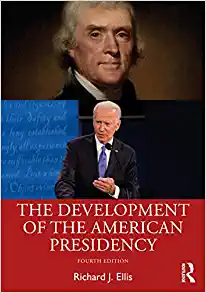 Description: A full understanding of the institution of the American presidency requires us to examine how it developed from the founding to the present. This developmental lens, analyzing how historical turns have shaped the modern institution, allows for a richer, more nuanced understanding. The Development of the American Presidency pays great attention to that historical weight but is organized by the topics and concepts relevant to political science, with the constitutional origins and political development of the presidency its central focus. Through comprehensive and in-depth coverage, Richard Ellis looks at how the presidency has evolved in relation to the public, to Congress, to the executive branch, and to the law, showing at every step how different aspects of the presidency have followed distinct trajectories of change. Each chapter promotes active learning, beginning with a narrative account of some illustrative puzzle that brings to life a central concept. A wealth of photos, figures, and tables allow for the visual presentations of concepts.
Old Tip vs. the Sly Fox: The 1840 Election and the Making of a Partisan Nation. University Press of Kansas, 2020.
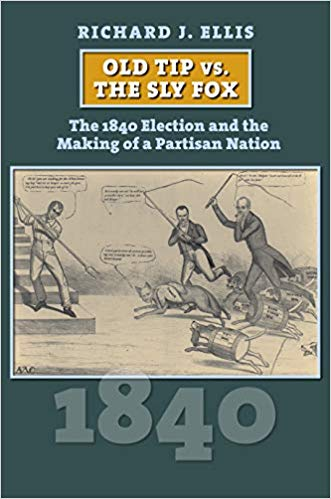
Description: Usually remembered for its slogan “Tippecanoe and Tyler too,” the election of 1840 is also the first presidential election of which it might be truly said, “It's the Economy, Stupid.” Tackling a contest best known for log cabins, cider barrels, and catchy songs, this timely volume reveals that the election of 1840 might be better understood as a case study of how profoundly the economy shapes the presidential vote.
Richard J. Ellis suggests that the election pitting the Democratic incumbent Martin Van Buren against Whig William Henry Harrison should also be remembered as the first presidential election in which a major political party selected—rather than merely anointed—its nominee at a national nominating convention. In this analysis, the convention’s selection, as well as Henry Clay’s post-convention words and deeds, emerge as crucial factors in the shaping of the nineteenth-century partisan nation. Exploring the puzzle of why the Whig Party’s political titan Henry Clay lost out to a relative political also-ran, Ellis teases out the role the fluctuating economy and growing anti-slavery sentiment played in the party’s fateful decision to nominate the Harrison-Tyler ticket. His work dismantles the caricature of the 1840 campaign (a.k.a. the “carnival campaign”) as all froth and no substance, instead giving due seriousness to the deeply held moral commitments, as well as anxieties about the political system, that informed the campaign.
In Old Tip vs. the Sly Fox, the campaign of 1840 can finally be seen clearly for what it was: a contest of two profoundly different visions of policy and governance, including fundamental, still-pressing questions about the place of the presidency and Congress in the US political system.
Historian in Chief: How Presidents Interpret the Past to Shape the Future (editor, with Seth Cotlar). University of Virginia Press, 2019

Description: Presidents shape not only the course of history but also how Americans remember and retell that history. From the Oval Office they instruct us what to respect and what to reject in our past. They regale us with stories about who we are as a people, and tell us whom in the pantheon of greats we should revere and whom we should revile. The president of the United States, in short, is not just the nation’s chief legislator, the head of a political party, or the commander in chief of the armed forces, but also, crucially, the nation’s historian in chief.
In this engaging and insightful volume, Seth Cotlar and Richard Ellis bring together top historians and political scientists to explore how eleven American presidents deployed their power to shape the nation’s collective memory and its political future. Contending that the nation’s historians in chief should be evaluated not only on the basis of how effective they are in persuading others, Historian in Chief argues they should also be judged on the veracity of the history they tell.
Debating the Presidency: Conflicting Perspectives on the American Executive, Fifth Edition (editor, with Michael Nelson). Congressional Quarterly, 2020 .
.
Description: The study of the presidency—the power of the office, the evolution of the institution, the men who have served—has generated a rich body of research and scholarship. What better way to get students to grapple with this literature than through conflicting perspectives on some of the most pivotal issues facing the modern presidency? Once again Ellis and Nelson have assembled a cadre of top scholars to offer pro/con essays that will inspire spirited debate beyond the pages of the book. Based on reviewers’ suggestions the authors have added new debate topics that include the presidential power to persuade, an up/down vote by Congress on legislation proposed by the president, presidential czars, the unitary executive, and the president’s war powers. Ellis and Nelson introduce each pair of essays, providing context and preparing students to read each argument critically, so they can decide for themselves which side of the debate they find most persuasive.
 Debating Reform: Conflicting Perspectives on How to Fix the American Political System, Fourth Edition, (editor, with Michael Nelson). Congressional Quarterly, 2020.
Description: Getting students to engage in debate always makes for a lively classroom. Yet when students only parrot partisan lines, an instructor is left to question if there is real pedagogical value in the exercise. Ellis and Nelson offer a fresh take on the traditional debate-style Reader. With pieces written specifically for this volume by top scholars in the field, each pro or con essay considers a concrete proposal for reforming the political system, from making it easier to amend the Constitution to adopting compulsory voting. By focusing on institutions, rather than liberal or conservative public policies, students tend to leave behind ideology and grapple with claims and evidence to draw their own conclusions and build their own arguments. Students will explore how institutions work in their American government text, but this reader helps them to understand how they can be made to work better.
Judging the Boy Scouts of America: Gay Rights, Freedom of Association, and the Dale Case, University Press of Kansas, 2014
Description: As Americans, we cherish the freedom to associate. However, with the freedom to associate comes the right to exclude t hose who do not share our values and goals. What happens when the freedom of association collides with the equally cherished principle that every individual should be free from invidious discrimination? This is precisely the question posed in Boy Scouts of America v. James Dale, a lawsuit that made its way through the courts over the course of a decade, culminating in 2000 with a landmark ruling by the U.S. Supreme Court. In Judging the Boy Scouts of America, Richard J. Ellis tells the fascinating story of the Dale case, placing it in the context of legal principles and precedents, Scouts policies, gay rights, and the "culture wars" in American politics. The story begins with James Dale, a nineteen year old Eagle Scout and assistant scoutmaster in New Jersey, who came out as a gay man in the summer of 1990. The Boy Scouts, citing their policy that denied membership to "avowed homosexuals," promptly terminated Dale's membership. Homosexuality, the Boy Scout leadership insisted, violated the Scouts' pledge to be "morally straight." With the aid of the Lambda Legal Defense Fund, Dale sued for discrimination. Ellis tracks the case from its initial filing in New Jersey through the final decision of the U.S. Supreme Court in favor of the Scouts. In addition to examining the legal issues at stake, including the effect of the Supreme Court's ruling on the law of free association, Ellis also describes Dale's personal journey and its intersection with an evolving gay rights movement. Throughout he seeks to understand the puzzle of why the Boy Scouts would adopt and adhere to a policy that jeopardized the organization's iconic place in American culture--and, finally, explores how legal challenges and cultural changes contributed to the Scouts' historic policy reversal in May 2013 that ended the organization's ban on gay youth (though not gay adults).
Judging Executive Power: Sixteen Supreme Court Cases That Have Shaped the American Presidency. Rowman and Littlefield, 2009.

Description: George W. Bush's presidency has helped accelerate a renewed interest in the legal or formal bases of presidential power. It is now abundantly clear that presidential power is more than the sum of bargaining, character, and rhetoric. Presidential power also inheres in the Constitution or at least assertions of constitutional powers. Judging Executive Power helps to bring the Constitution and the courts back into the study of the American presidency by introducing students to sixteen important Supreme Court cases that have shaped the power of the American presidency. The cases selected include the removal power, executive privilege, executive immunity, and the line-item veto, with particularly emphasis on a president's wartime powers from the Civil War to the War on Terror. Through introductions and postscripts that accompany each case, landmark judicial opinions are placed in their political and historical contexts, enabling students to understand the political forces that frame and the political consequences that follow from legal arguments and judgments.
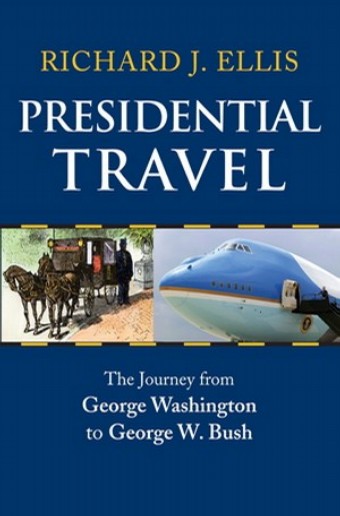 Presidential Travel: The Journey from George Washington to George W. Bush. University Press of Kansas, 2008.
Description: In office less than half a year, President George Washington undertook an arduous month-long tour of New England to promote his new government and to dispel fears of monarchy. More than two hundred years later, American presidents still regularly traverse the country to advance their political goals and demonstrate their connection to the people.
In this first book-length study of the history of presidential travel, Richard Ellis explores how travel has reflected and shaped the changing relationship between American presidents and the American people. Tracing the evolution of the president from First Citizen to First Celebrity, he spins a lively narrative that details what happens when our leaders hit the road to meet the people.
Presidents, Ellis shows, have long placed travel at the service of politics: Rutherford "the Rover" Hayes visited thirty states and six territories and was the first president to reach the Pacific, while William Howard Taft logged an average of 30,000 rail miles a year. Unearthing previously untold stories of our peripatetic presidents, Ellis also reveals when the public started paying for presidential travel, why nineteenth-century presidents never left the country, and why earlier presidents--such as Andrew Jackson, once punched in the nose on a riverboat--journeyed without protection.
Ellis marks the fine line between accessibility and safety, from John Quincy Adams skinny-dipping in the Potomac to George W. clearing brush in Crawford. Particularly important, Ellis notes, is the advent of air travel. While presidents now travel more widely, they have paradoxically become more remote from the people, as Air Force One flies over towns through which presidential trains once rumbled to rousing cheers. Designed to close the gap between president and people, travel now dramatizes the distance that separates the president from the people and reinforces the image of a regal presidency.
As entertaining as it is informative, Ellis's book is a sprightly account that takes readers along on presidential jaunts through the years as our leaders press flesh and kiss babies, ride carriages and trains, plot strategies on board ships and planes, and try to connect with the citizens they represent.
 To the Flag: The Unlikely History of the Pledge of Allegiance. University Press of Kansas, 2005.
Description: For over one hundred years, it has been deeply ingrained in American culture. Saluting the flag in public schools began as part of a national effort to Americanize immigrants, its final six words imbruing it with universal hope and breathtaking power. Now Richard Ellis unfurls the fascinating history of the Pledge of Allegiance and of the debates and controversies that have sometimes surrounded it.
For anyone who has ever recited those thirty-one words, To the Flag provides an unprecedented historical perspective on recent challenges to the Pledge. As engaging at it is informative, it traces the story from the Pledge's composition by Francis Bellamy in 1892 up to the Supreme Court's action in 2004 regarding atheist Michael Newdow's objection to the words "under God." Ellis is especially good at highlighting aspects of this story that might not be familiar to most readers: the schoolhouse flag movement, the codification of the Pledge at the First National Flag Conference in 1923, changing styles of salute, and the uses of the Pledge to quell public concerns over sundry strains of radicalism.
The Pledge has inspired millions but has also been used to promote conformity and silence dissent - indeed its daily recitation in schools and legislatures tells us as much about our anxieties as a nation as they do about our highest ideals. Ellis reveals how, for over a century, those who have been most fearful about threats to our national identity have often been most insistent on the importance of patriotic rituals. Indeed, by addressing this inescapable paradox of our civic life, Ellis opens a new and unexpected window on the American Soul.
Published by University Press of Kansas, 2005.
 Democratic Delusions: The Initiative Process in America. University Press of Kansas, 2002.
Description: It is becoming common in many states: citizens seizing the opportunity to reclaim government from politicians by signing a petition to put an initiative on the ballot and then voting on it. During the past decade alone, Americans voted on nearly 500 statewide initiatives. Particularly in the West, direct legislation increasingly defines and dominates the political agenda.
Although this may appear to be democracy in action, Richard Ellis warns us that the initiative process may be putting democracy at risk. In Democratic Delusions he offers a critical analysis of the statewide initiative process in the United States, challenging readers to look beyond populist rhetoric and face political reality.
Through engaging prose and illuminating anecdotes, Ellis shows readers the "dark side" of direct democracy - specifically the undemocratic consequences that result from relying too heavily on the initiative process. He provides historical context to the development of initiatives - from their Populist and Progressive roots to their accelerated use in recent decades - and a comparative context in which to understand the variations among states in their initiative processes.
Published by University Press of Kansas, 2002.
 Founding the American Presidency. Rowman and Littlefield,1999.
Description: At a time when the institution of the presidency seems in a state of almost permanent crisis, it is particularly important to understand what sort of an institution the framers of the Constitution thought they were creating. Founding the American Presidency offers a first-hand view of the minds of the founders by bringing together extensive selections from the constitutional convention in Philadelphia as well as representative selections from the subsequent debates over ratification. Pointed discussion questions provoke students to consider new perspectives on the presidency. Ideal for all courses on the presidency, the book is also important for all citizens who want to understand not only the past but the future of the American presidency.
Published by Rowman & Littlefield, 1999
Reviews: "Absolutely first rate - Richard Ellis is a superb writer and a thorough and original scholar. Founding the American Presidency is well conceived and well executed, perfect for any course on the presidency." Michael Nelson, Rhodes College
"The author has done an excellent job of conveying the fact that there was a real debate over the presidency specifically and the Constitution in general in which reasonable arguments could be found on both sides. Few texts accomplish this feat." Andrew Busch, University of Denver
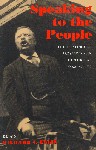 Speaking to the People: The Rhetorical Presidency in Historical Perspective (editor). University of Massachusetts Press, 1998.
Description: Americans today expect their president to speak directly to them on the issues of the day - to address their concerns, to ask for their support, even to feel their pain. Yet, as the essays in this volume make clear, this was not always the case. During the early years of the republic, such behavior would have been deemed beneath the president's office, undignified at best, demagogic at worst. How, then, did the practice of "speaking to the people" evolve from the icy reserve of George Washington to the effusive empathy of Bill Clinton?
This book explores how the "rhetorical presidency" became a central feature of American politics. Beginning with a fresh look at the framing of the Constitution, the essays examine the role of rhetoric in a variety of nineteenth-century presidencies, as well as in the crucial turn-of-the-century presidencies of William McKinley, Theodore Roosevelt, and Woodrow Wilson. Viewed against this historical backdrop, the "modern" presidencies of Franklin Roosevelt and his successors appear less a break with the past than a culmination of developments in popular leadership and rhetorical practice that began more than a century before.
Published by University of Massachusetts Press, 1998.
Reviews: "These fine essays crystallize the debates about the presidency's communications with the people in American political development. The collection is informationally rich and conceptually subtle, and it is framed well by Ellis's thoughtful introduction and Jeffrey Tulis's engaged conclusion. Ellis's volume will enrich scholars as well as inform students." Peri E. Arnold, author of "Making the Managerial Presidency: Comprehensive Reorganization Planning, 1905-1980.
 The Dark Side of the Left: Illiberal Egalitarianism in America. University Press of Kansas, 1998.
Description: Why do people who identify themselves as liberal or egalitarian sometimes embrace intolerance or even preach violence? Illiberalism has come to be expected of the right in this country; its occurrence on the left is more paradoxical but no less real. Although equality lies at the heart of the liberal tradition, the earnest pursuit of egalitarian goals has often come at the expense of other liberal ideals.
In this provocative book, Richard J. Ellis examines the illiberal tendencies that have characterized egalitarian movements throughout American history, from the radical abolitionists of the 1830s to the New Left activists of the 1960s. He also takes on contemporary radical feminists like Catherine MacKinnon and radical environmental groups like Earth First! to show that, even today, many of the American left's sacred cows have cloven hooves.
Ellis identifies the organizational and ideological dilemmas that caused Students for a Democratic Society to transform itself from a democratic to an elitist organization, or that allow radicals to justify illegal acts as long as they are free of self-interest. He explains how orthodoxy arises within a group from the need to maintain distance from a society it views as hopelessly corrupt, and how individuals committed to egalitarian causes are particularly susceptible to illiberalism - even poets like Walt Whitman, who celebrated the common people but often expressed contempt for their mundane lives. Political correctness, idealizing the oppressed, and an affinity for authoritarian and charismatic leaders are all parts of what Ellis calls "the dark side of the left."
Published by University Press of Kansas, 1998.
 Culture Matters: Essays in Honor of Aaron Wildavsky (editor, with Michael Thompson). Westview Press, 1997.
Description: Culture Matters explores the role of political culture studies as one of the major investigative fields in contemporary political science. Cultural theory was the focal point of the late Aaron Wildavsky's teaching and research for the last decade of his life, a life that profoundly affected many fields of political science from the study of the presidency to public budgeting. Hence, in this volume, original essays prepared in Wildavsky's honor examine the arenas of rationale choice, institutions, theories of change, political risk, the environment, and practical policies.
Published by Westview Press, 1997.
 Presidential Lightning Rods: The Politics of Blame Avoidance. University Press of Kansas, 1994.
Description: H.R. Haldeman, President Nixon's former chief of staff, is said to have boasted: "Every president needs a son of a bitch, and I'm Nixon's. I'm his buffer and I'm his bastard. I get done what he wants done and I take the head instead of him."
Richard Ellis explores the widely discussed but poorly understood phenomenon of presidential "lightning rods" - cabinet officials who "take the heat" instead of their bosses. Whether by intent or circumstance, these officials divert criticism and blame away from their presidents. The phenomenon is so common that it's assumed to be an essential item in every president's managerial toolbox. But, Ellis argues, such assumptions can oversimplify our understanding of this tool.
Ellis advises against indiscriminate use of the lightning rod metaphor. Such labeling can hide as much as it reveals about presidential administration and policymaking at the cabinet level. The metaphor often misleads by suggesting strategic intent on the president's part while obscuring the calculations and objections of presidential adversaries and the lightning rods themselves.
Published by University Press of Kansas, 1994.
Reviews: "Ellis explores an important - but often misunderstood - tool in a president's kit-bag of political and strategic management. 'When to take the blame?' and 'Who is to take the blame?' are crucial questions all recent presidents have faced and will continue to face. Ellis provides an interesting an timely analysis of the 'lightening rod' phenomenon." John P. Burke, author of "The Institutional Presidency."
Politics, Policy, and Culture (editor, with Dennis J. Coyle). Westview Press, 1994.
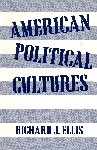 American Political Cultures. Oxford University Press, 1993.
Description: This work challenges the thesis first formulated by de Tocqueville and later systematically developed by Louis Hartz, that American political culture is characterized by a consensus on liberal capitalist values. Ranging over three hundred years of history and drawing upon the seminal work anthropologist Mary Douglas, Ellis demonstrates that American history is best understood as a contest between five rival political cultures: egalitarian community, competitive individualism, hierarchical collectivism, atomized fatalism, and autonomous hermitude.
Published by Oxford University Press, 1993.
Reviews: "A useful and clear map of a road well traveled by those who have tried to come to terms with the complexity of American political life." American Political Science Review, "A valuable critical survey of the latest scholarship on the history of America's troublesome political culture." American Historical Review
"Extraordinarily intelligent, insightful, documented . . . a book that gives genuine pause to all of us who still think of ourselves as strongly and rightfully influenced by Louis Hartz's seminal work." The Review of Politics
 Cultural Theory (with Michael Thompson and Aaron Wildavsky). Westview Press, 1990.
Description: Taking their cue from the pioneering work of anthropologist Mary Douglas, the authors of "Cultural Theory" have created a typology of five ways of life - egalitarianism, fatalism, individualism, hierarchy, and autonomy - to serve as an analytic tool in the examination of people, culture, and politics. They then show how cultural theorists can develop large numbers of falsifiable propositions.
Published by Westview Press, 1990.
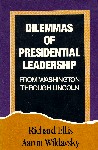 Dilemmas of Presidential Leadership: From Washington Through Lincoln (with Aaron Wildavsky). Transaction Publishers, 1989.
Description: Dilemmas of Presidential Leadership challenges the widely accepted distinction between "traditional" and "modern" presidencies, a dichotomy by which political science has justified excluding from its domain of inquiry all presidents preceding Franklin Roosevelt. Rather than divide history into two mutually exclusive eras, Ellis and Wildavsky divide the world into three sorts of people - egalitarians, individualists, and hierarchs. All presidents, the authors contend, must manage the competition between these rival political cultures. It is this commonality that lays the basis for comparing presidents across time.
The unique dimension of this volume is its use of cultural theory to explain presidential behavior. It also differs from other books in that it deals with pre-modern presidents who are too often treated as only of antiquarian interest in mainstream political science literature on the presidency. The analysis lays the groundwork for a new basis for comparison of early presidents with modern presidents.
Published by Transaction Publishers, 1989.