We have already said that there are only three ways left to Japan to escape
from the pressure of surplus population. We are like a great crowd of people
packed into a small and narrow room, and there are only three doors through
which we might escape, namely emigration, advance into world markets, and
expansion of territory. The first door, emigration, has been barred to us
by the anti-Japanese immigration policies of other countries. The second door,
advance into world markets, is being pushed shut by tariff barriers and the
abrogation of commercial treaties. What should Japan do when two of the three
doors have been closed against her? It is quite natural that Japan should
rush upon the last remaining door.
It may sound dangerous when we speak of territorial expansion, but the territorial
expansion of which we speak does not in any sense of the word involve the
occupation of the possessions of other countries, the planting of the Japanese
flag thereon, and the declaration of their annexation to Japan. It is just
that since the Powers have suppressed the circulation of Japanese materials
and merchandize abroad, we are looking for some place over seas where Japanese
capital, Japanese skills and Japanese labor can have free play, free from
the oppression of the white race. We would be satisfied with just this much.
What moral right do the world powers that have themselves closed to us the
two doors of emigration and advance into world markets have to criticize Japan’s
attempt to rush out of the third and last door?
If they do not approve of this, they should open the door that they have closed
against us and permit the free movement overseas of Japanese emigrants and
merchandise. . . .
At the time of the Manchurian incident, the entire world joined in criticism
of Japan. They said that Japan was an untrustworthy nation. They said that
she had recklessly brought cannon and machine guns into Manchuria, which was
the territory of another country, flown airplanes over it, and finally occupied
it. But the military action taken by Japan was not in the least a selfish
one. Moreover, we do not recall ever having taken so much as an inch of territory
belonging to another nation. The result of this incident was the establishment
of the splendid new nation of Manchuria. The Powers are still discussing whether
or not to recognize this new nation, but regardless of whether or not other
nations recognize her, the Manchurian empire has already been established,
and now, seven years after its creation, the empire is further consolidating
its foundations with the aid of its friend, Japan.
And if it is still protested that our actions in Manchuria were excessively
violent, we may wish to ask the white race just which country it was that
sent warships and troops to India, South Africa, and Australia and slaughtered
innocent natives, bound their hands and feet with iron chains, lashed their
backs with iron whips, proclaimed these territories as their own, and still
continues to hold them to this very day.
See this Asia-Focus article from 2007:
"The Manchurian Incident, the League of Nations and the Origins of the Pacific War. What the Geneva Archives Reveal"
Yoshizawa Tatsuhiko
At 9:18 p.m. on Sept. 18 of this year, I was standing in front of the Sept. 18 History Museum in Shenyang, China. It was raining. A siren went off. It sounded like the wailing of a fire engine.
On this day each year, Shenyang holds a ceremony to mark the anniversary of a military crackdown against the city's unsuspecting citizens by the Imperial Japanese Army. This year was the 76th anniversary of that event.
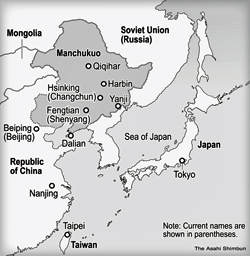
Japanese forces swiftly overran a vast area of northeastern China. The annual ceremony seeks to keep this memory alive. It is also serves as a prayer for peace.
The wailing of the siren, reminiscent of an air-raid alert, lasted three minutes. High school students, soldiers and armed police officers all turned out for the ceremony and stood rigidly at attention in the rain.
Two days later, I was in the nearby city of Fushun to attend a symposium on the Second Sino-Japanese War (1937-1945). There, I had the unexpected pleasure of meeting Zhang Lushi, a 45-year grandson of Zhang Zuolin, who was known in the English-speaking world as the Warlord of Manchuria until his assassination by Japanese agents three years before the Manchurian Incident.
Zhang Zuolin
Zhang told me the organizers of the symposium had asked him to attend. His uncle, Zhang Xueliang, was Zhang Zuolin's son. He became the effective ruler of Manchuria and much of northeastern China after his father's assassination, but remained exiled from his domain after the Manchurian Incident.
In 1949, he was transferred to Taiwan, where all other members of the Zhang clan also relocated.
Zhang Lushi, too, did not return to his ancestral city of Shenyang until May this year. According to Lushi, his uncle was reluctant to talk about the past. However, he often mentioned to family members that he "could never figure out what the Japanese thought about the Chinese people."
The year after the Kwantung Army (see Fact File) staged the Manchurian Incident, the League of Nations sought to investigate the cause from an objective standpoint and try to resolve the Sino-Japanese conflict. The international body dispatched a commission to China, headed by Victor Bulwer-Lytton, the second Earl of Lytton.
The commission put together what is known as the Lytton Report, which portrayed Japan in a very different light from what most Japanese citizens believed at the time. As a result, Japan withdrew from the League of Nations, and became increasingly xenophobic and hostile toward the West.
What sort of people did Lytton meet in China? What were the stories he heard, and what did he see? To find answers, I decided to retrace his footsteps in China.
Communist Party the greater enemy
Why did the League of Nations send the Lytton Commission to China in the first place? At the time of the Manchurian Incident, the top priority of Chiang Kai-shek's nationalist government, whose capital was Nanking (now called Nanjing), was to eliminate the Communist Party as the "arch enemy" at home, rather than stand up to the invading Japanese army. Chiang immediately appealed to the League of Nations to deal with the Japanese invasion, thereby putting the problem in the international arena.
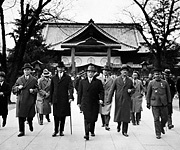
March 1932, Lytton Commission at Yasukuni Shrine. Lytton is second left
For the League of Nations that was born after World War I, the Manchurian Incident represented the first major international conflict. Japan was a permanent member of the Council, which effectively controlled the world body. China had only become a nonpermanent member four days before the Manchurian Incident. In other words, the positions of Japan and China were in reverse of what they are today in the United Nations Security Council, where China is a permanent member and Japan is not.
According to the Lytton Report, the team arrived in Japan in February 1932. Usui Katsumi, professor emeritus at the University of Tsukuba, notes in his book that the Lytton Commission met with Prime Minister Inukai Tsuyoshiand other top government officials in Tokyo and heard them out.
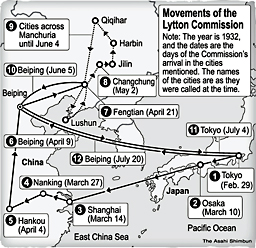
In China, the team met with Chiang and other top Nanking officials, and then moved on to Beiping (present-day Beijing), where they were met by Zhang Xueliang and others. Zhang, who had been driven out of Manchuria, hosted a welcoming reception and gave an impassioned speech.
Zhang Xueliang
"Ethnically, politically and economically, the Three Northeastern Provinces (Manchuria) are an integral part of China," Zhang asserted. "The true cause of the conflict is that Japan has become jealous of China for moving toward unification. Japan is trying to seize the Three Northeastern Provinces."
Was China capable of national unification? On this point, the Chinese and the Japanese disagreed completely.
Denied contact
Lytton was most interested in, but also had the hardest time, talking to ordinary citizens of Manchuria to hear their stories. This was because the Japanese government and its puppet, Manchukuo, prevented the Lytton Commission from coming in contact with the citizenry on the pretext of ensuring the safety of the team members. The Lytton Report notes to the effect that meetings with citizens "were always conducted amid extreme difficulties and in secret."
How did the citizens approach Lytton and his team and what did they tell them? Wang Jianxue, a curator at the Sept. 18 History Museum, gave me a name: Gong Tianmin, a banker who was in Fengtian (present-day Shenyang) at the time.
According to Wang, more than 100,000 citizens of Fengtian fled to Beiping and other cities. But Gong stayed put, and began organizing a resistance movement against the invading Japanese. He organized Christian youths into a volunteer army, and urged them to write letters to the Lytton Commission.
The Lytton Report actually mentions that many letters were received from students and young people who refused to recognize Manchukuo.
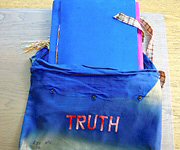
In July 2005, the Shenyang Evening News, a local daily, ran a story about Gong's activities, based on an interview with his son, Gong Quoxian. The article says that when Gong and his eight partners learned of the imminent arrival of the Lytton Commission, he determined to tell the members that the Manchurian Incident had been planned and executed by the Japanese, and that the new Manchurian regime was a puppet of the Japanese government. To substantiate his accusations, Gong secretly collected material evidence and compiled the information into a booklet. Titled "Truth," the booklet was entrusted to the safekeeping of an English clergyman residing in Shenyang. The clergyman, in turn, invited Lytton to dinner at his home and handed him the booklet. The article also notes that the clergyman and Lytton happened to be related.
Is this story accurate? When I asked Wang, he replied, "It's a familiar story, but its historic authenticity has not been verified. And we haven't confirmed what happened to the booklet, either."
I asked a third party to arrange an interview with Gong Quoxian, but the request was turned down for reasons that were never quite clear to me. Feeling at a loss, I pinned my last hope on the library at the United Nations Office in Geneva, where archival materials concerning the League of Nations are kept.
"Did Lytton really receive 'Truth'?" I inquired at the library. Two days later, the library responded to the effect that the booklet had been located among League-related materials.

League of Nations Headquarters, Geneva
Bound in the style of a photo album with its front cover lined with blue fabric, the booklet was encased in a bag made of matching fabric. On the bag, the word "Truth" was embroidered in pink.
The booklet contains 75 information items, and some of the more prominent among them are titled as follows:
(1) List of names of innocent citizens who were shot by Japanese soldiers after Sept. 18, 1931;
(2) List of rewritten and deleted passages in school textbooks; and
(3) Letters censored by the Japanese military police.
Attached to the booklet was a 27-page typewritten letter in English explaining each item. Some of these pieces of evidence were obtained at great personal risk, the letter notes, and goes on to describe the premeditated nature of the Liutiaohu Incident and the subsequent Japanese violation of Chinese sovereignty, as well as the Japanese military's role in the establishment of Manchukuo.
The dynamiting of a section of the Japanese-owned South Manchuria Railway was used as a pretext for Japan's armed invasion, the letter states. The founding of Manchukuo was directed and manipulated by the Japanese, it adds.
The letter concludes with this desperate plea: Please remember that more than 95 percent of the Manchurian population is Chinese. The Chinese people desire to remain Chinese, and will do so forever.
All nine people who participated in the compilation of this booklet signed their names and identified their professions. However, the booklet I saw was missing all parts pertaining to anything that might suggest their identities. Perhaps they were removed by the League of Nations to protect their safety.
Chinese national sentiment rises
The Lytton Commission received 1,550 letters while it was in Manchuria. According to the Lytton Report, "all but two letters" were vehemently hostile toward the Japanese and the "new Manchurian government."
The report concluded to the effect: Having carefully examined the evidence, presented at official and private meetings as well as through letters and statements, we have concluded that the 'new Manchurian government' is perceived by the Chinese people as a puppet of the Japanese government, and that it does not have the support of the Chinese public. As for the operations of the Japanese Army, the report refuted the Japanese claim of self-defense.
Sensing that the Lytton Report was not going to be in its favor, Japan proclaimed Manchukuo as an independent state in September 1932 just days before the report was released. The following year, Japan was the sole voice of dissent when the League of Nations adopted a resolution against recognition of Manchukuo's statehood. Its permanent Council membership notwithstanding, Japan withdrew from the League.
With the number of Chinese people who lived through the Manchurian Incident diminishing every year, I asked a local historian in Shenyang to find a survivor, and was introduced to Zhao Lizhi. At 95, he was living in a home for the elderly.
Born and raised in the northernmost province of Heilongjiang, Chao was an impoverished tenant farmer at the time of the Manchurian Incident. "We all felt the Guomindang had abandoned us northeasterners," he recalled. The year after the incident, he said, Japanese soldiers came to his village. Zhao joined a local resistance movement against the Japanese, and eventually became a guerrilla fighter.
Participating in anti-Japanese activities awakened a sense of national identity in the Chinese people. Bu Ping, director of the Institute of Modern History at the Chinese Academy of Social Sciences, noted: "The Chinese awareness of their own national identity, which began to bud around the time of the Opium War, surged with the September 18 Incident and remained strong throughout the Second Sino-Japanese War. The Manchurian Incident served as the cue for the Chinese to unite."
Zhang Xueliang (1901-2001)
The eldest son of Zhang Zuolin (1875-1928), Zhang Xueliang, inherited his father's "Warlord of Manchuria" mantle upon the latter's assassination at the hands of the Japanese military in 1928, and declared his support for the Guomindang nationalist government of Chiang Kai-shek.
In 1936, Zhang put Chiang under house arrest in an attempt to get him to discontinue his policy of nonresistance against the Japanese and fighting the communists. Chiang's physical confinement resulted in the Guomindang and the Communist Party forming a united front against the Japanese military. Zhang, however, would be put under house arrest and eventually transferred to Taiwan in 1949.
Lytton Commission
The Lytton Commission was dispatched by the League of Nations to investigate the Manchurian Incident. Headed by Victor Bulwer-Lytton, a former British governor of Bengal and son of a former Viceroy of India, the commission consisted of five members representing Britain, the United States, France, Germany and Italy. The Lytton Commission toured Japan and China from February 1932, and compiled the Lytton Report in autumn of that year. The commission refuted the Japanese claim that Manchukuo was a result of a spontaneous independence movement. But it also took Japan's interests into consideration and proposed the creation of an autonomous government under the auspices of the League of Nations, with Japan playing a central role.
The world in the 1920s
International society in the 1920s gave rise to a cooperative order known as the Washington System. The League of Nations was established in hopes of bringing international disputes to negotiated settlements.
The early years of the decade saw the signing of several treaties at the Washington Naval Conference. Among them were the Five-Power Treaty that limited the naval capabilities of its five signatories, and the Nine-Power Treaty that affirmed China's sovereignty and territorial integrity.
In 1928, the war-renouncing Pact of Paris, also known as the Kellogg-Briand Pact, was signed in the French capital.
Meanwhile, the Soviet Union and communism--the outcome of the 1917 Russian Revolution--were perceived as threats by the Imperial Japanese Army.
Then came the Great Depression of 1929. Yamamuro Shinichi, a Kyoto University professor, notes in his book that in 1931, it was a common practice among Japanese farmers to sell their daughters. Also that year, the ranks of undernourished children swelled, while labor disputes spiked to a pre-World War II record level amid rampant joblessness in cities.
The following year, family suicides occurred with unprecedented frequency, and the nation's suicide rate registered a record high, based on statistics on causes of death that were first compiled in 1900.
These desperate economic and social circumstances formed a backdrop to the creation of Manchukuo in 1932.
Fact File: Manchurian Incident
The Manchurian Incident was the starting point of Japan's invasion of northeastern China (Manchuria) and Inner Mongolia. By a narrow definition, the duration of the "incident" spans from the dynamiting of the South Manchurian Railway near Liutiaohu on Sept. 18, 1931, to the conclusion of the Tangku cease-fire treaty on May 31, 1933. By a broader definition, it went on until the Marco Polo Bridge Incident of July 7, 1937, that triggered the all-out, so-called Eight-Year War. In China, the Manchurian Incident is referred to as the September 18 Incident.
To avoid being accused of violations of international law and war-renouncing treaties, the Japanese government of the time obtained Cabinet approval to refer to the military operations in Manchuria as jihen (incident), not war proper.
As spoils of its victory in the Russo-Japanese War (1904-1905), Japan had come into possession of Lushun and Dalian as leased territories, as well as control over the South Manchuria Railway. These holdings were referred to as "special rights and interests," and Japan valued them greatly. When a move to regain them surged in China, Japan's Kwantung Army, which was permanently stationed in Manchuria, blew up a section of the South Manchurian Railway near Liutiaohu in suburban Fengtian (present-day Shenyang), and passed it off as a sabotage by the Chinese military to justify the invasion of Manchuria. This was the Liutiaohu Incident.
The Kwantung Army sought to seize control of Manchuria and eastern Inner Mongolia. But as the top brass of the Imperial Japanese Army did not approve, the government created the puppet regime of Manchukuo, installing Pu Yi, the last Qing emperor, as its nominal ruler.
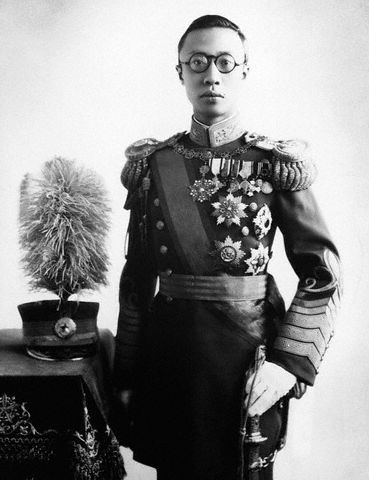
Pu Yi
Fact File: Kwantung Army
The Kwantung Army was a unit of the Imperial Japanese Army stationed permanently in the Kwantung Leased Territory on the Liaodong Peninsula, where Lushun and Dalian are situated. Kwantung means "east of Shanhaiguan," an area at the eastern end of the Great Wall of China.
The unit was originally established to defend the Kwantung Leased Territory and the Japanese-controlled South Manchurian Railway. It was reorganized in 1919 and came to be called the Kwantung Army.
Until the Manchurian Incident in 1931, the army was a little over 10,000-strong. The Kwantung Army was responsible for planning the assassination of Zhang Zuolin as well as orchestrating the Liutiaohu Incident. After the Manchurian Incident, the troop strength was reinforced to suppress anti-Japanese resistance and engage in campaigns to invade northern China and Inner Mongolia. The notorious 731 Unit, which conducted human experiments to develop chemical weapons, was a unit of the Kwantung Army.
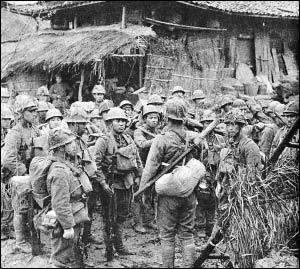
Kwantung Army soldiers in the field
Tokyo's Shin-Okubo district in Shinjuku Ward is a melting pot of Asian cultures. The streets echo to the sounds of Korean, Chinese, Mongolian, Vietnamese, Thai and Malaysian with smells of traditional foods emanating from ethnic restaurants that line the streets. One is run by a native of the Yanbian Korean Autonomous Prefecture in northeastern China, where the Japanese puppet state of Manchukuo was established decades ago.
Ho Soodong, 43, a visiting researcher at Hitotsubashi University, took me to the restaurant, saying it offers a taste of his hometown. Ho's father moved to Yanbian from southern Korea with his family in 1938, when he was 8 years old.
In Korea, a Japanese colony at the time, many farmers were deprived of their land, causing them financial distress. They had no choice but to cross the border to seek new horizons in northeastern China. The move was accelerated by Japan's immigration policy, which aimed to bolster its presence in Manchuria.
Two things crossed my mind while I was talking with Ho, whose specialty is studying Korean settlers in Manchuria. I began to ponder the historical ties between Manchukuo and former Japanese colonies such as Korea and Taiwan. I also wondered about the link between Manchukuo and modern-day Japan, as symbolized by the Shin-Okubo district's cultural mix.
Japan has a rising population of foreign residents--as if to make up for the nation's shrinking population and declining birthrates. Japan had 2.085 million foreign residents from 188 countries as of the end of 2006, up nearly 50 percent from a decade earlier. The figure accounts for 1.6 percent of the overall population. With people from so many cultural backgrounds co-existing, I thought there were lessons to be learned from Manchukuo's failed policy of Gozoku Kyowa.
The slogan advocated by Imperial Japan literally translates as five races living in harmony. In Manchukuo's case, they were Han, Manchu, Mongolian, Korean and Japanese. When I asked Ho for his view, he said people should regard this period of history based on the recognition that Gozoku Kyowa was an outright "lie."
I flew to Changchun, which went by the Japanese-designated name of Hsinking when it was the capital of Manchukuo. The city resembles a virtual theme park of living history. It is dotted with buildings that Japan erected based on grand city planning during the Manchukuo era. Many of the imposing structures are still used as universities, hospitals and other facilities.
The building that housed the former State Council, the supreme organ of the Manchukuo government, is a mix of traditional Western and Chinese architectural styles. It looks like the Diet building in Tokyo.
I was particularly surprised when I saw the magnificent building in the city center that had served as the command of the Kwantung Army. One look was enough to make me realize that Japan had ruled over Manchukuo. That is because the building resembles a Japanese castle. Today, it is occupied by the Chinese Communist Party's Jilin province committee, the supreme authority of this region. It clearly shows how power changed hands.
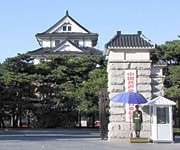
I then met Zhang Zhiqiang, 55, an official at the provincial archives, whose job is to organize and store documents on the military police and other organs during the Manchukuo era. When I asked why the committee is using the building of an aggressor instead of razing it, Zhang cited two reasons.
First, the building was still relatively new when Manchukuo collapsed following Japan's defeat in World War II in 1945. The structure was built by Chinese even though it was designed by Japanese. "It was natural (for the Chinese people) to use what they had built with their own blood and sweat," Zhang said.
The second reason is that the building has been preserved for the purpose of providing "patriotic education" to young Chinese. "Things that date back to the time when China was invaded--if left as they used to be--can serve as a living testimony to history," Zhang said.
14 years of occupation
Visitors to the building are indeed reminded of the fact that they are standing on land that used to be Manchukuo. A metal plaque on the facade notes that it is a historic site of Wei Manzhouguo (false Manchukuo). I wondered about the use of the word "false" since the structure is a solid relic of Manchukuo.
In China, the period from the Manchurian (Mukden) Incident in 1931 to the collapse of Manchukuo in 1945 is called the 14 years of Dongbei Lunxian, or occupation of northeastern China. The term connotes the period of Chinese people's humiliation at having their land and dignity trampled on by Japanese aggressors.
Twenty years ago, a project got under way to document the history of Japanese occupation of northeastern China. I visited the Jilin Provincial Academy of Social Sciences to meet with Sun Jiwu, 81, who serves as the project's editor in chief. "False Manchukuo means not recognizing Manchukuo," he said. "It is a country established by Japan, the country which took our land."
Under the Manchukuo regime, Chinese children were required to study the Japanese language from elementary school. Sun remembers that his teacher called him an "idiot" and hit him when he could not distinguish the pronunciations of the Japanese words tabako (tobacco) and tamago (egg). Teachers did not reprimand Japanese pupils even when they beat Chinese children. The children were also segregated during morning assembly.
Sun said he thought Gozoku Kyowa was a joke and his antipathy toward Japan kept growing.
From the late 1980s to the late 1990s, Sun and his colleagues interviewed more than 100 farmers who lived in communities where Japanese settlers arrived during the Manchukuo era. The interviews uncovered the agony of Chinese farmers who were deprived of their land by the Imperial Japanese Army. The farmers had no choice but to flee to the mountains and reclaim barren wasteland or to work as tenant farmers under Japanese settlers, many of whom were also poor.
Sun said they, too, were victims of Japanese aggression and that some of them had friendly relations with Chinese farmers. But he added: "Generally speaking, the Japanese had a sense of superiority. They believed they were a superior race and thought the Chinese were inferior."
Such a mentality was symbolized by the way students were required to bow in the direction of the Imperial Palace each day. First, they had to bow in the direction of Tokyo, where Emperor Hirohito, posthumously known as Emperor Showa, lived, and then in the direction of the palace where the Manchukuo emperor resided. Even schoolchildren understood that Manchukuo was a Japanese puppet state because of the order in which they observed the ritual.
Ho, the Hitotsubashi University researcher, was born in China's Yanbian Korean Autonomous Prefecture near the border with North Korea. It was chilly at the airport in the prefectural capital of Yanji, and the city's cold must have been hard on people who came from southern Korea during the Manchukuo period. Still, the Korean population in the region rose after Korea became a Japanese colony and, in particular, after the establishment of Manchukuo.
Sun Chunri, 49, director of the Institute of Nationalities at Yanbian University, said there were two groups of Korean immigrants. They were either people who fled their native land because they detested Japanese colonial rule or had been stripped of their land because they failed to present ownership certificates in a land survey launched by Japanese authorities, or for some other reasons. In either case, Japan's colonial policy played a key role in accelerating the movement.
While Korean immigration to northeastern China can be traced back to the 17th century, it gained momentum after Japan established supremacy in the region. According to Sun, the number of Koreans topped 1 million by the Manchurian Incident and peaked at 2.3 million during the Manchukuo era. He said many Koreans hoped to try their luck after Japan established Manchukuo and launched a campaign to promote the notion of Odo Rakudo (paradise of benevolent government) in Korea.
"Despite strong anti-Japanese sentiment, many Koreans had developed a sense of resignation that they were no match for Japan," Sun said. "Some Koreans, meanwhile, came to develop a sense of superiority as they were treated like Japanese."
In 1936, Japan started a planned immigration policy. The plan called for moving 1 million Japanese farming households over a 20-year period to raise the number of Japanese immigrants to 10 percent of Manchuria's overall population. The government failed to recruit enough Japanese to achieve the target and tried to encourage 10,000 Korean households to settle each year.
Anti-Japanese movements
At the same time, the Japanese military had a hard time controlling movements among Koreans against Manchukuo and Japan. The military kept Korean farmers in secluded hamlets to prevent them from developing contact with anti-Japanese elements.
Monuments dedicated to anti-Japanese fighters can be found across the Yanbian Korean Autonomous Prefecture. They are a testament to the intensity of Japanese oppression and the large number of people who fell victim to it.
Jin Zhezhu, 58, a prefectural museum researcher, said the region has a 38-year history of anti-Japanese movements because they started in 1907, when Japan opened a branch of its resident general of Korea.
Taiwanese in Manchuria
Just as Korea was linked to Manchuria because it was a Japanese colony, Taiwan also developed ties with northeastern China.
Hsu Hsueh-chi (Xu Xueji), 54, who heads Academia Sinica's Institute of Taiwan History in Taipei, has since the 1990s conducted research on Taiwanese who lived in Manchuria. When she studied the February 28, 1947, massacre of residents by the Guomindang government and the oppression that followed, Hsu noticed that many victims had returned from Manchuria.
Researchers on Japanese colonial rule had focused on Taiwanese who joined the Guomindang in Chongqing in southwestern China but not on those who went to Manchuria, she said. When she gathered information on some 700 people who lived in Manchuria, Hsu was impressed with the large number of doctors involved. Graduates of the Manchuria medical college alone topped 100, followed by government employees.
Hsu said many Taiwanese went to Manchuria where they were treated equally as Japanese and could play active roles in society. "Taiwan at the time had few institutes of higher education," she said. "Landing jobs was not easy, and there was a wide gap in wages between Taiwanese and Japanese workers." In addition, many young people went to Manchuria because they admired Xie Jieshi, a Taiwan native who became Manchukuo's first foreign minister, according to Hsu.
Hsu interviewed some 50 people who had returned from Manchuria, but they were reluctant to talk. The returnees feared for their safety because Xie Jieshi was labeled a "traitor to China" after World War II. One of those Hsu interviewed was Li Shuiqing, who was among the first graduates of Kenkoku University (national foundation university), Manchukuo's highest institution of learning.
Li, 89, said he was passionate about the ideal of Gozoku Kyowa when he entered the school. It had Korean, Russian and Mongolian students in addition to Japanese and Chinese. Li spent six years living with them in a dormitory. "I still retain close ties with old students who are like my brothers," he said in fluent Japanese.
Li was poor, and the tuition-free Kenkoku University was like a dream come true. The school not only paid for meals and other living expenses but also provided students with an allowance. While it was common in Manchukuo for Japanese to eat rice and for Chinese to sup on gaoliang grain, students at the dormitory ate the same meals in protest against such discrimination. Looking back on his experience, Li said that Kenkoku University entered a period of turmoil around 1940 in its third year and eventually collapsed.
The Kwantung Army cracked down on dissidents at the end of 1941, when Japan entered into war against the United States and Britain. Some Kenkoku University students were arrested and died in prison.
During the Guomindang government's crackdown on Taiwanese residents in 1947, Li's junior in school was killed. While Li himself spent 2 1/2 years in prison, he believes he was fortunate to have attended Kenkoku University. "I was able to learn to see things from different viewpoints because I went to school with people of different nationalities," he said.
But that was inside the school walls. Outside, Manchukuo was full of inconsistencies.
Manchukuo and the Myth of Gozoku Kyowa
A Chinese official was installed as the top administrator in name only. Real power was in the hands of the Japanese. To begin with, Manchukuo had no nationality law. Legally, Manchukuo citizens did not exist.
Li said there was no need for a nationality law because Japan had planned to annex Manchukuo. If Li's reasoning is correct, it should not be surprising that Manchukuo developed ties with Taiwan and Korea, which were already Japanese colonies.
In interviews for this story, many people used the term, a "sense of superiority," in reference to Japanese people they came across during the Manchukuo era. With such a "sense" on the Japanese side, it is little wonder that the slogan of Gozoku Kyowa ended in a lie.
How should we build a modern society to live in harmony with people of different races? In searching for an answer, I realized that I need to reflect on whether deep down I, too, look down on foreign people and cultures.
Fact File: Pu Yi
Pu Yi (1906-1967), or Emperor Xuantong, was the last emperor of the Qing Dynasty. His family name was Aisin-Gioro. He ascended to the throne in 1908, when he was 2 years old, and abdicated in 1912, following the Xinhai Revolution.
Pu Yi was held by Japanese military forces during the Manchurian Incident and installed as leader of Manchukuo when it was established in 1932. He was crowned emperor of Manchukuo two years later, taking the name Emperor Kangde.
Pu Yi was captured by the Soviet Union after Japan's defeat in World War II. He was convicted of being a war criminal in China in 1950 but was granted special pardon in 1959. In his autobiography, Pu Yi wrote: "The Kwantung Army was like a high-voltage power source, and I was like a motor that reacted with precision and alacrity."
Fact File: Manchukuo
Manchukuo was established in northeastern China in 1932 on land Japan occupied as a result of the Manchurian Incident the year before. It is generally accepted that Manchukuo was a Japanese puppet state, with Pu Yi, the last emperor of the Qing Dynasty, as the token ruler. The Qing Dynasty was founded by the Manchus.
The Kwantung Army, or the Imperial Japanese Army based in Manchuria, thought it could avoid international criticism against Manchukuo if it installed Pu Yi, a Manchu, as head of state. But the League of Nations refused to recognize Manchukuo as such.
Manchukuo was recognized by only about 20 countries, including Germany and Italy, Japan's allies in World War II, and Thailand, Burma and other countries that were under Japanese control during the Pacific War.
Manchukuo covered an area of 1.3 million square kilometers, about 3.4 times the size of present-day Japan. The state extended over what is now the three northeastern Chinese provinces of Liaoning, Jilin and Heilongjiang as well as parts of the Inner Mongolian Autonomous Region and Hebei province.
Its population increased to 42 million by 1940, up from 30 million at the time it was established. Chinese accounted for about 90 percent of the total population, followed by Koreans and Mongolians. Japanese formed a minority of only about 2 percent. Some 230,000 Japanese civilians lived there when Manchukuo was established. The number had risen to 1.55 million by the time Japan was defeated in World War II. Of them, more than 200,000 died during repatriation.
More than 600,000 Japanese soldiers and civilian settlers, who were mobilized by the army immediately before Japan's defeat, were detained by the Soviet Union and were sent to Siberia. More than 60,000 of them died in internment.
Fact File: Gozoku Kyowa and Odo Rakudo
Imperial Japan used these two slogans both at home and abroad as ideals of Manchukuo, with the propaganda particularly aimed at inspiring Japanese.
Gozoku Kyowa, which called for the five races of Han, Manchu, Mongolian, Korean and Japanese to live in harmony, was initially advocated by members of the Federation of Youth in Manchuria, which was organized by civilian Japanese residents in Manchuria. Its leaders included Ozawa Kaisaku, the father of conductor Ozawa Seiji.
Japanese residents represented less than 1 percent of the total population when Manchukuo was established. Anti-Japanese sentiment grew among the Han, who accounted for an overwhelming majority of residents. Under such circumstances, the Japanese had no other choice but to advocate "harmony."
Odo Rakudo calls for building a paradise in which all people can live happily under "benevolent government," instead of oppressive rule enforced by military power. Still, Japan advocating this ideal was a paradox from the start because it established Manchukuo by force.
This is a slightly abbreviated version of a two-part article that appeared in the International Herald Tribune/Asahi Shinbun on November 30,2007. Posted at Japan Focus on December 1, 2007.